Pick-Up Party: Why the School Run Is the Best Warm-Up for a Kids’ Celebration

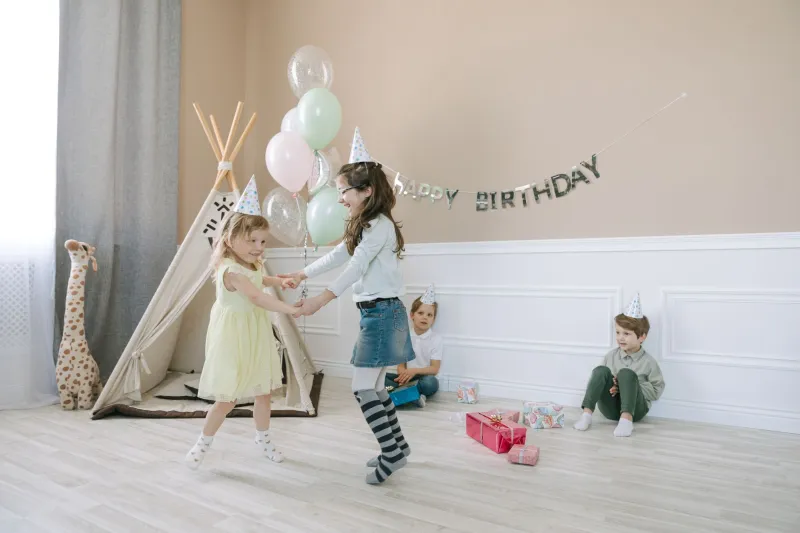
Most kids’ parties follow the same familiar script: a weekend slot, a hall booked for three hours, a mountain of sausage rolls and a slow-motion meltdown around 3pm. It works, but it is not the only way. In 2026, more parents are looking at the school run and seeing a smarter starting point. A tight after-school party, starting around 4pm and finishing before tea time properly collapses, can be a brilliant alternative to the full weekend production.
The idea is simple: use the fact that children are already together, already in school mode and already being collected. Then keep the celebration short, focused and honest about what young guests can actually handle on a weekday evening.
Why the school bell changes the mood
There is a particular kind of chaos that comes from gathering twenty children in a weekend hall when they have spent all morning climbing trees or staring at tablets. An after-school party catches them at a different point in the day. They are tired, yes, but they are also socialised, used to following instructions and already in the same place. The transition from classroom to party room is often shorter than the transition from home to party room.
It also solves a very practical problem: weekends are crowded. Football, swimming, family visits, birthday clashes and the general admin of modern life all compete for the same few hours. A weekday slot can feel less demanding because it slots into a routine everyone already understands. Parents drop off, run a quick errand or have a cup of tea, then collect on the way home.
The catch is that the timing has to be respected. This is not a three-hour rave with a disco tunnel. It is a short, well-paced celebration with a clear beginning, middle and end.
The timetable that keeps everyone upright
A workable after-school party usually looks something like this: collection at the school gate, a short walk or drive to the venue, arrival by 3:45pm, and a finish around 5:15pm to 5:30pm. That gives you roughly ninety minutes of proper party time, which is often plenty.
Use the first fifteen minutes for arrival and free play. Children need a moment to dump bags, find their friends and work out where the loo is. Then move into a light tea. Keep it simple: small sandwiches, fruit, veg sticks, cheese cubes, crackers and a jug of water. This is not the main meal of the day. It is fuel.
Games work best in short blocks of ten to fifteen minutes. A craft table, a pass-the-parcel, musical statues and a colouring corner can all run alongside each other. Avoid long elimination games that leave half the room sitting out and getting restless. Cake should come near the end, not at the start, so the sugar rush has somewhere to go before pick-up.
Finish with a calm activity: a story, a short film clip or a simple sticker challenge. It gives parents a buffer if they are running late and stops the last ten minutes turning into a shoe hunt.
Food that does not derail the evening
The phrase ‘tea time’ does a lot of heavy lifting here. Many children will go home and have their actual tea after the party, so you are not catering a full dinner. Think tea-adjacent: enough to stop hunger, not so much that everyone feels sluggish.
A few practical rules help. Keep portions small. Offer water alongside any squash. Label allergy information clearly and ask parents to flag anything in advance. If you are doing cake, cut it near the end and send slices home in napkins rather than expecting everyone to sit through a long ceremonial slice. And resist the urge to provide a second pudding. One sweet moment is enough.
Games with a natural finish line
The best after-school games are the ones that can be stopped without tears. Musical statues, sleeping lions, a simple treasure hunt and a decorating station all work because they do not rely on a single winner or a long knockout round.
If you have space, set up two or three stations and let children move between them. That prevents a queue forming and gives quieter guests somewhere to go. A book corner is not a failure. It is a pressure valve.
Invites and parent logistics
Be very clear on the invitation. Start time, finish time, venue, pick-up arrangements and whether siblings are welcome. If children are being collected by someone other than a parent, ask for that in writing. A school-gate WhatsApp group is fine, but a simple paper invite with a QR code to a sign-up form can save a lot of repetition.
If you are relying on parents to walk children from school to the venue, confirm that in advance. Parking near schools is rarely fun, and a small party should not begin with a traffic argument. Pair up with another parent where you can.
When the weekend still wins
An after-school party is not a universal fix. A big milestone birthday, a family spread across the country or a party that includes grandparents may still suit a weekend. But for a class-sized celebration with a clear guest list and a modest budget, the 4pm window is hard to beat. It is shorter, calmer and often cheaper, and it leaves the weekend free for the things that do not fit neatly around the school bell.
The best parties are not always the longest ones. Sometimes they are the ones that start when everyone is already together and finish before anyone has had time to fall apart.